

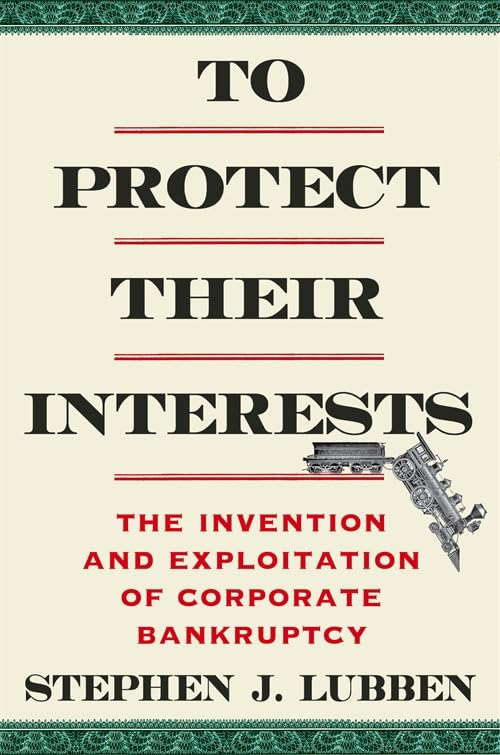
Summary:
Chapter 11 corporate bankruptcy proceedings are commonly thought of as a tool to protect the broader economy from the failure of large firms, even though the biggest players reap the greatest rewards. In the conventional telling, modern corporate reorganization began in the 1890s, with J. P. Morgan leading a noble effort to protect bondholders from the depredations of corporate insiders. What does this story leave out, and how do the true origins of bankruptcy law shed light on its present-day uses and abuses?
To Protect Their Interests is a groundbreaking historical account of how corporate bankruptcy became what it is today—a forum for battles between well-heeled insiders. Stephen J. Lubben strips away the myths surrounding the history of corporate restructuring, showing that it emerged a decade before Morgan, when the robber baron Jay Gould strove to keep control of his railroad by working out a compromise with a handful of wealthy investors. The 1885 restructuring of Texas and Pacific Railway set the pattern for future corporate reorganizations: insider dealing, elite manipulation of the legal system, and judicial deference. Lubben traces the evolution of the bankruptcy system through a series of major cases involving companies such as W. T. Grant and Toys “R” Us, demonstrating that it has always been a way for the powerful to maintain power. Revealing the sordid origins of bankruptcy law, this book also considers the limited prospects for reform.
Commentary: Control, Venue, and the Enduring Power Struggle in Bankruptcy
Stephen Lubben’s To Protect Their Interests is, at its core, a history of control. While it is nominally about corporate insolvency—moving from railroad receiverships through modern Chapter 11—it reads as a continuous case study in how sophisticated debtors and their financial backers have always sought to dictate the terms of reorganization by choosing the forum, shaping the process, and minimizing oversight.
Lubben’s narrative reminds us that bankruptcy law has never been merely about distributing value; it has been about who gets to steer the ship during distress and who emerges holding the wheel afterward.
From Jay Gould to the Texas Two-Step: Venue as Strategy:
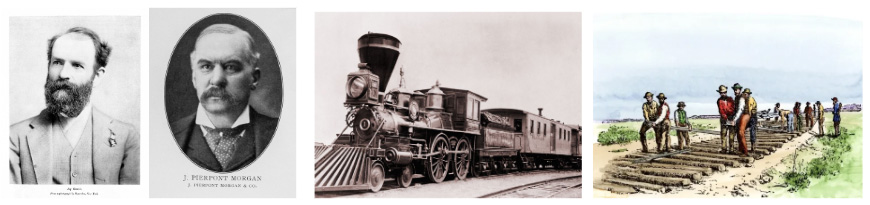
Lubben traces how late-19th-century railroad reorganizations, orchestrated by figures like Jay Gould and J.P. Morgan, used equity receiverships as proto-bankruptcies. These were not neutral judicial proceedings; they were curated events. Friendly courts were selected. Receivers were aligned with management. Committees were structured to ensure continuity of control. The entire point was to “protect their interests”—and those interests were the insiders’ and dominant creditors’, not dispersed stakeholders.
The modern echo of that dynamic is unmistakable in contemporary mass-tort restructurings and the so-called “Texas Two Step.” Whether by divisional mergers, strategic entity creation, or venue engineering, the animating principle remains constant: secure a forum where the debtor—or the capital structure controlling it—can manage the process with minimal interference from trustees, regulators, or even an overly inquisitive judge.
Lubben’s great contribution is not simply recounting these episodes, but showing their continuity. The tools change; the objective does not. Control during the case determines leverage over plan formulation, claim valuation, and ultimately the distribution of enterprise value. Control after the case determines who actually owns the reorganized entity. Everything else is, in many respects, procedural detail.
Avoiding Oversight: Trustees, the SEC, and the “Nosy Judge” Problem
Another throughline in Lubben’s history is the persistent corporate debtor impulse to avoid external supervision. Early receiverships sidestepped robust judicial involvement. Later iterations of bankruptcy prompted the creation of SEC oversight precisely because Congress recognized that reorganization could become an insiders’ game. The subsequent retreat from SEC involvement in Chapter 11 did not eliminate the instinct to manage the forum—it simply shifted the battlefield to venue selection and case architecture.
One cannot read this history without seeing how modern corporate debtors seek to cabin the influence of:
- Independent trustees (rare in large Chapter 11 cases);
- Government oversight (now largely through the U.S. Trustee rather than the SEC);
- Judges whose enthusiasm for aggressive case management might disrupt the negotiated script.
The historical lesson is sobering: procedural reforms repeatedly attempt to rebalance power, but sophisticated repeat players adapt, using structure and venue to reclaim the initiative.
The Stark Contrast: Consumer Bankruptcy as a Regime of Scrutiny
If To Protect Their Interests chronicles the steady expansion of autonomy for corporate debtors, it simultaneously highlights—by contrast—the intensely supervised environment imposed on consumer debtors.
A consumer Chapter 7 or Chapter 13 debtor:
- Hostility to selecting a “friendly” or even merely "convenient" venue;
- Faces an automatic trustee investigation and extended supervision;
- Even though 11 U.S.C. §1321 provides that "The debtor shall file a plan", Chapter 13 Trustees routinely object to those plans for the benefit of otherwise silent and absent creditors;
- Is subject to mandatory documentation, means testing, and §341 examination; and
- Encounters routine judicial scrutiny on even modest plan provisions.
The asymmetry is striking. Corporate debtors can often choreograph complex restructurings in jurisdictions selected for predictability or debtor-friendliness. Consumers, by contrast, are funneled into a tightly regulated, trustee-driven process in which even small discretionary expenditures or asset valuations can draw objection.
In short, Lubben’s history implicitly confirms what consumer practitioners experience daily: the Bankruptcy Code is functionally bifurcated. Corporate reorganization is a "negotiated" process. Consumer bankruptcy is an audited entitlement program.
A Provocative Question: Could Consumers Replicate the Playbook?
Lubben’s work invites an uncomfortable hypothetical. If venue engineering and entity structuring are legitimate tools for corporate debtors, could consumers theoretically deploy similar strategies?
Imagine a consumer forming a wholly owned shell corporation in a perceived debtor-friendly jurisdiction, placing certain assets or liabilities into that entity, filing the corporate case first, and then filing a personal bankruptcy relying on the corporate case to anchor venue. On paper, this is merely the retail version of strategies routinely used in large Chapter 11 filings.
Would courts welcome the increased filings? Or would they recoil at what suddenly looks like “forum shopping” when individuals practice it rather than massive enterprises?
History suggests the answer. Courts and policymakers have repeatedly tolerated aggressive venue strategies when employed by sophisticated corporate actors, often framing them as efficiency-enhancing or necessary for complex restructurings. But when similar creativity appears in consumer cases, it is more likely to be labeled bad faith or manipulation of the system.
That double standard exposes the deeper truth Lubben’s book reveals: the tolerance for procedural innovation correlates closely with the perceived legitimacy and economic importance of the debtor. Railroads, asbestos defendants, and mass-tort conglomerates are treated as systemically significant reorganizations deserving procedural flexibility. Individual wage earners are treated as risks to the integrity of the system if they attempt comparable maneuvers.
Would Courts Compete for Consumer Cases?
Lubben’s historical account of courts positioning themselves as preferred forums for major reorganizations raises a further question: if consumers could replicate these tactics at scale, would certain jurisdictions begin competing for those filings?
One suspects not. Consumer cases are high-volume but low-fee and administratively burdensome. Unlike mega-Chapter 11s, they do not generate prestige, professional fees, or the institutional attention that large restructurings command. The economic incentives that quietly encourage venue flexibility for corporate debtors simply do not exist in the consumer context.
Indeed, the likely response would be doctrinal tightening: more aggressive policing of venue, expanded findings of bad faith, and perhaps legislative amendments aimed at closing the perceived loophole. In other words, the system that accommodates structural ingenuity in corporate insolvency would likely move quickly to suppress it in consumer practice.
Final Thoughts: Control as the Central Axis of Bankruptcy
Lubben’s To Protect Their Interests ultimately teaches that bankruptcy history is less about statutory evolution than about governance: who controls the case, who controls the negotiations, and who controls the reorganized enterprise.
For corporate debtors—from Gould’s railroads to modern mass-tort defendants—success has often meant retaining meaningful control throughout the process while minimizing intrusive oversight. For consumer debtors, the process begins with surrendering control to trustees, compliance regimes, and judicial supervision, in exchange for the promise of a fresh start.
That divergence is not an accident of doctrine; it is the product of historical development shaped by economic power and institutional priorities. Lubben’s work forces us to confront whether our modern bankruptcy system still “protects their interests”—and whose interests those really are.
Blog comments