

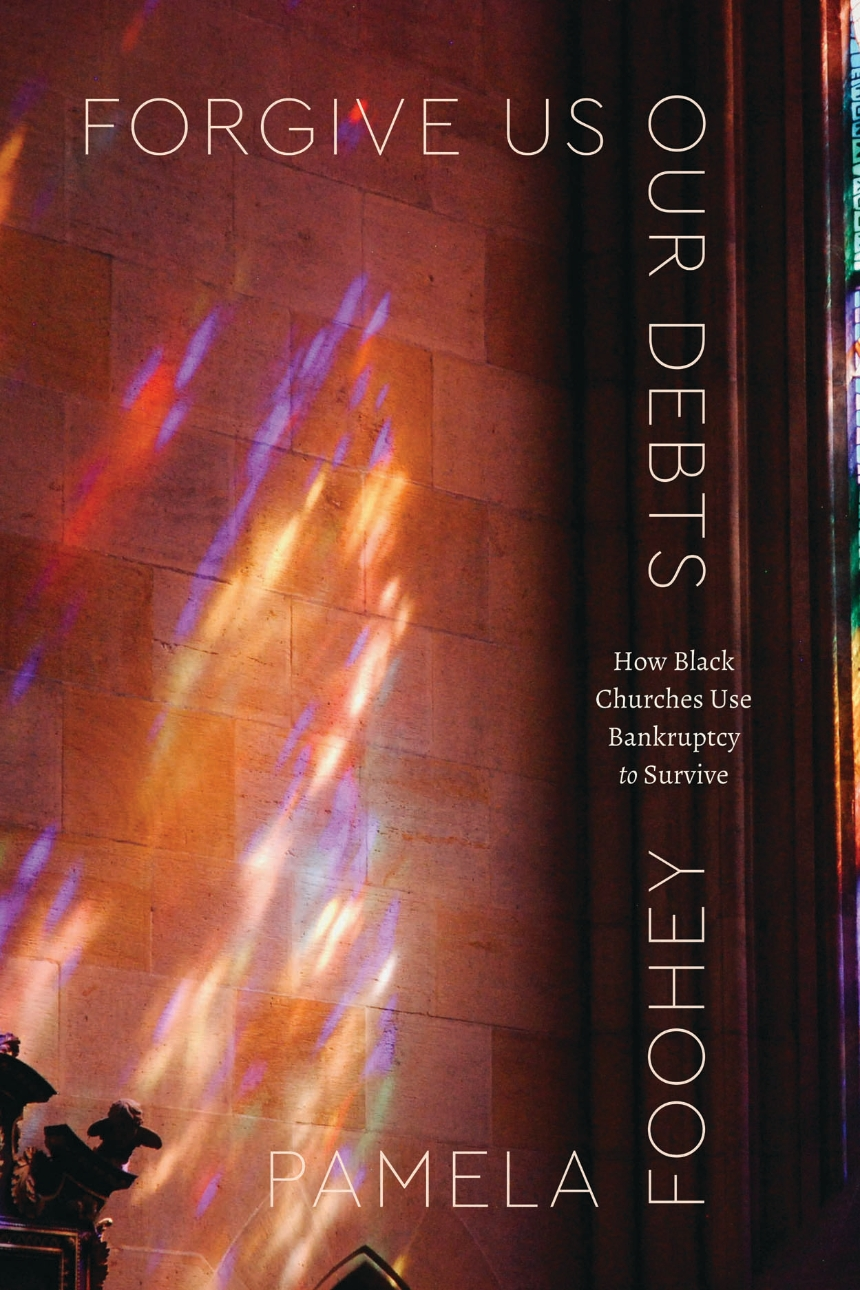
Available at: University of Chicago Press
Summary:
Professor Pamela Foohey’s new book, Forgive Us Our Debts: How Black Churches Use Bankruptcy to Survive, starts with a striking empirical fact: Black churches make up a disproportionately large share of congregations that reorganize under Chapter 11. Foohey examines why, drawing on more than 1,000 church bankruptcy cases, case studies of six Black churches and one white church, and approximately 150 interviews with church leaders, members, and attorneys.
Her answer is not that Black churches are inherently worse managed, more geographically vulnerable, organized differently, or unusually prone to financial mistakes. Instead, the book focuses on lending markets—particularly a history of more onerous credit and lenders that frequently became difficult or impossible to negotiate with once trouble arose. Bankruptcy then becomes not merely a last refuge from failure, but a mechanism that forces lenders to the table, brings transparency to negotiations, protects accumulated equity, and sometimes gives a congregation enough breathing room to survive. That basic description and purpose are central to the book.
Foohey organizes the book around churches’ progression from financial distress, through the decision to file, through reorganization and plan confirmation, and finally to what happens after bankruptcy. The destination matters: the conclusion is expressly titled “Bankruptcy as a Pathway to Survival.”
That is an important and welcome corrective to the usual narrative about bankruptcy.
Bankruptcy as Leverage, Not Confession
Foohey’s work is excellent precisely because it takes bankruptcy seriously as an institution rather than merely as an accounting event. These churches often had valuable buildings, viable congregations, continuing income and communities that depended on them. Their central difficulty was frequently a creditor relationship that had become impossible outside bankruptcy.
Chapter 11 changed the negotiating environment.
Foohey writes elsewhere that almost every church in her dataset owned a building and that most filed while facing foreclosure or its threat. More than half ultimately emerged either still owning their spiritual home or with sufficient value to relocate and continue as a congregation. Without reorganization, many likely would have dissolved.
That is what bankruptcy is supposed to do.
The automatic stay, disclosure requirements, judicial supervision, claim allowance process and ability to restructure debt create leverage that a debtor often simply does not possess outside bankruptcy. Foohey’s churches illustrate that vividly. Filing was not necessarily evidence that the organization had ceased to function. Often it was the thing that finally made a functioning organization’s lender negotiate.
Foohey deserves considerable credit for taking these relatively small Chapter 11 cases seriously enough to study them in depth. Bankruptcy scholarship understandably gravitates toward giant corporate reorganizations, mass torts and headline cases. Her focus on congregation institutions that are economically small but socially enormous to the people who depend upon them, reveals much more about what reorganization can actually accomplish.
But reading Forgive Us Our Debts as a consumer bankruptcy lawyer also raises another question:
What can these church Chapter 11 cases teach us about Chapter 13?
Quite a lot.
Forgive Us Our Debts—Literally
For a book titled Forgive Us Our Debts, there is surprisingly little attention to the source of that phrase.
The Lord’s Prayer is perhaps the most familiar invocation of debt forgiveness in Western religion. The Old Testament’s Jubilee provisions, which form the basis for bankruptcy law in the Anglo-American legal tradition, likewise connect debt relief with restoration rather than moral failure. Biblical concern for debtors, the poor, widows, strangers and people dispossessed of their property is hardly obscure.
And financial rescue among Christian communities is not a modern invention. Acts 11 describes assistance sent from Antioch to Christians in Judea. Paul later organized a much broader collection among churches in Macedonia, Achaia and Galatia for impoverished Christians in Jerusalem. Debt relief, collective assistance and preservation of communities are comfortably within the biblical tradition.
Consumer bankruptcy attorneys encounter the contrary assumption every day.
Many debtors, particularly religious debtors, arrive believing that filing bankruptcy is morally suspect. Some have been told, explicitly or implicitly, that a good Christian “pays his debts.” Lawyers wind up providing not only legal advice but amateur theology: explaining that scripture has considerably more to say about mercy, Jubilee, protection of the poor and forgiveness of debt than about eternally binding borrowers to creditors.
Pastors contemplating bankruptcy for their churches should probably know that history too. So should their Chapter 11 lawyers.
The irony is particularly sharp where a church feels shame about using bankruptcy to renegotiate a mortgage while apparently feeling no comparable theological discomfort about negotiating that same loan outside bankruptcy. Why does moving the negotiation into a federal courthouse suddenly turn prudent financial restructuring into a moral failure?
The bank will have a lawyer either way.
The debtor should too.
Churches, Pastors and the “Doubting Thomas” Problem
Another subject that receives relatively little attention is the bankruptcy experience of the people sitting in the pews.
Professor Robert Lawless estimated in 2020 that roughly 10% of Americans—about 33 million people—had personally filed bankruptcy. Even allowing for the limitations of that estimate, bankruptcy is commonplace enough that a congregation of any substantial size almost certainly includes people who have filed.
That presumably includes some pastors.
I confess that I have sometimes had a personal prejudice about Chapter 13 cases filed by pastors. Their proposed budgets and plans occasionally seem to rely more heavily on faith than on cold, hard arithmetic. A Chapter 13 plan based on expected offerings, uncertain supplementary employment and optimism about future expenses can cause a bankruptcy lawyer to become something of a Doubting Thomas.
Foohey’s research caused me to reconsider that skepticism.
If church organizations whose income depends on voluntary giving can successfully reorganize in Chapter 11—and Foohey finds considerable success—perhaps consumer lawyers should be slower to treat similar uncertainty as uniquely disqualifying when the debtor is the pastor rather than the church.
That does not mean faith substitutes for feasibility.
Bankruptcy remains a solution for debt problems, not income problems, whether the debtor is General Motors, Greater New Hope Missionary Baptist Church or Pastors John and Jane Doe.
But Foohey has persuaded me that a little more grace in evaluating the feasibility of these cases may be appropriate.
What Counts as a Successful Bankruptcy?
One of the book’s most useful insights for consumer bankruptcy may be its broader conception of success.
For these churches, success can mean several different things:
- confirming a Chapter 11 plan;
- forcing a mortgage lender finally to negotiate;
- delaying foreclosure long enough for the congregation to reorganize;
- preserving equity that otherwise would disappear in foreclosure;
- reaching the conclusion that the existing building must be surrendered;
- keeping the congregation intact even after relocation; or
- galvanizing church members around the institution’s financial survival.
Consumer bankruptcy scholarship and practice often use a far narrower measure.
A Chapter 13 case ending in discharge is labeled successful.
A Chapter 13 case ending in dismissal or conversion is labeled unsuccessful.
That is easy to measure. It is not necessarily accurate.
A debtor may file Chapter 13, stop a foreclosure, cure several months of mortgage arrears, dispose of an unaffordable automobile, repay tax debt, obtain a mortgage modification and then voluntarily dismiss the case.
Was that a failure?
A homeowner might obtain three years in a house, giving children time to finish school before surrendering it.
Failure?
A debtor might use bankruptcy to force a servicer to correct an account, then refinance and pay the Chapter 13 off.
Success surely cannot depend solely on whether a discharge order eventually appears on PACER.
Foohey’s relatively small universe of church reorganizations permits something that becomes much harder with hundreds of thousands of consumer cases: asking what actually happened to the debtor.
Consumer bankruptcy researchers should ask more often.
So should lawyers.
“Checking In Early and Often”
One of the most practical lessons from Foohey’s interviews is also one of the least complicated: successful church reorganizations were associated with bankruptcy lawyers who stayed involved and checked in early and often.
That should sound familiar to every Chapter 13 attorney.
A five-year consumer reorganization cannot be adequately represented by preparing the petition, attending the § 341 meeting, confirming the plan and then waiting for either discharge or a motion to dismiss.
Income changes.
Cars break.
Mortgage payments change.
Escrow accounts go sideways.
Medical bills arrive.
Marriages begin and end.
Children leave home—or come back.
Jobs disappear.
Chapter 13 cases need maintenance.
The economics, however, are dramatically different.
According to the figures reflected in Foohey’s research, church Chapter 11 attorneys may receive retainers around $12,500, with total fees commonly at least $25,000 and average totals around $40,000–$50,000, sometimes even after substantial discounts. By contrast, consumer Chapter 13 attorneys frequently begin cases with little, or nothing, paid upfront and may receive total fees around $5,000 over several years. The current court filing fee itself is $1,738 for Chapter 11 and $313 for Chapter 13.
Nobody should be shocked that $40,000 of legal work permits more “early and often” attention than $5,000 does.
That is not criticism of Foohey’s work. It is a lesson from it.
If intensive attorney involvement helps make Chapter 11 reorganization successful, courts, trustees, academics and policymakers should hesitate before simultaneously insisting that consumer Chapter 13 lawyers provide the same kind of continuing representation while treating reasonable attorney compensation as money diverted from creditors.
Lawyers cannot check in early and often if the system expects them to work late and for free.
Chapter 11 Gets a Balloon; Chapter 13 Gets a Straitjacket
The comparison becomes still more interesting when we look at the restructuring tools available.
A church may be able to restructure commercial mortgage debt through Chapter 11 by making reduced payments for a period and leaving balloon payment to be refinanced later. That can provide five years in which to stabilize contributions, rebuild operations, create a positive payment history and become financeable again.
Consumer debtors face much tighter restrictions.
Section 1322(b)(2) generally prevents modification of a claim secured only by the debtor’s principal residence, and § 1325(a)(5)(B)(iii)(I)—not § 1325(b)—requires periodic payments on secured claims subject to that provision to be in equal monthly amounts.
That greatly limits the ability of Chapter 13 to reproduce a commercial-style restructuring in which the debtor makes sustainable interim payments and refinances a substantial balloon later.
There is another important practical difference.
A church seeking refinancing may present a prospective lender with financial statements and an individualized payment history. A consumer emerging from Chapter 13 is overwhelmingly judged by standardized credit reporting.
Mortgage servicers frequently stop furnishing meaningful positive mortgage payment information during a Chapter 13 case, often explaining that they are avoiding complications arising from the automatic stay.
Whatever the motive, the result is perverse.
A debtor can spend three or five years making every post-petition mortgage payment and emerge with a credit report that does not adequately document that performance. That makes refinancing harder, which makes paying the existing lender harder.
If the objective is successful rehabilitation, perhaps mortgage servicers—or even Chapter 13 trustees where payments flow through them—should have a mechanism for reliably reporting timely post-petition payments.
A bankruptcy system should not make successful performance invisible.
When Owing the Bank Enough Finally Gets Its Attention
Foohey’s churches also illustrate the old observation commonly associated with John Maynard Keynes (converted from Pounds Sterling to Dollars but not inflation adjusted): if you owe the bank a $1,000, you have a problem; owe the bank $1 million, the bank has a problem.
Church properties frequently involved enough collateral, equity and institutional importance that Chapter 11 finally forced mortgage lenders to negotiate seriously.
That should immediately remind consumer bankruptcy lawyers of bankruptcy mortgage-modification programs.
These programs use judicial supervision, document exchange protocols, deadlines and accountability to accomplish at scale what Foohey describes happening in church Chapter 11 cases: getting lenders and borrowers into the same process, forcing actual communication and preventing one side from simply hiding behind bureaucracy.
One pastor described bankruptcy as finally requiring the lender to deal openly because the court was watching:
“Bankruptcy cause the lender to be open with their dealings. They couldn’t conceal stuff. They couldn’t throw a rock at us and hide their hands because the court was very much involved. So it gives the little guy a feeling of somebody is out there that will do something to help.”
That is practically a mission statement for court-supervised mortgage modification.
Bankruptcy courts that have discontinued those programs, including, regrettably, the Eastern District of North Carolina, should reconsider what was lost.
Bankruptcy Courts Are Also Consumer Courts
Foohey suggests that discriminatory or predatory lending to churches might also be addressed through laws such as ECOA or the Fair Housing Act, whether by churches themselves or through enforcement by government agencies.
Consumer bankruptcy lawyers, particularly NACBA and ABLI members, learned a related lesson following enactment of BAPCPA and because of the mortgage crisis.
Sometimes the best place to litigate a non-bankruptcy consumer claim is bankruptcy court.
RESPA.
Regulation X and Regulation Z.
The FDCPA.
State servicing and unfair-practices statutes.
ECOA.
Claims arising from mortgage accounting, foreclosure conduct or debt collection do not cease to matter simply because the debtor filed bankruptcy. To the contrary, bankruptcy may expose them.
That raises a question suggested by Foohey’s research: Why have Chapter 11 lawyers representing churches not made greater use of those tools?
Perhaps some did, and the book’s focus lies elsewhere. A complete answer would require examination of the underlying cases and interviews.
But consumer practitioners have spent two decades developing an increasingly sophisticated understanding that a bankruptcy lawyer sometimes needs to be a consumer-protection lawyer too.
Chapter 11 attorneys representing churches may have something to learn from that experience.
Where Is the Trustee?
There is another structural difference.
Chapter 11 generally leaves the debtor in possession. Trustees are exceptional.
Chapter 13 always has a standing trustee.
Section 1302(b)(4) expressly requires a Chapter 13 trustee to “advise, other than on legal matters, and assist the debtor in performance under the plan.”
Yet consumer debtors frequently experience the trustee principally as the party seeking additional payments, objecting to confirmation or moving to dismiss their case.
That is not entirely unfair: trustees have statutory duties to creditors and to the integrity of the system too.
But Foohey’s church cases raise an interesting institutional question. If church debtors succeed in significant numbers while their own attorneys essentially provide the continuous guidance necessary to negotiate and perform a reorganization, what might Chapter 13 look like if its standing trustees more visibly emphasized the statutory obligation to assist debtors in completing plans?
There is also cost.
Standing Chapter 13 trustees collect a percentage fee from plan payments; federal law caps that fee at 10 percent.
That is an expense church Chapter 11 debtors generally do not bear in the same form.
Especially if the Chapter 13 Trustee is collecting a commission on disbursing monthly mortgage payments under a conduit plan, that can quickly mount up. Trustees should ensure that they are providing sufficient added value for the debtor to justify those fees.
It would be far too simplistic to attribute differences in outcome to trustees alone, but the comparison is worth considering.
The Missing Lawyers
One aspect of the book struck me as a bit odd.
Church leaders and churches are frequently identified, apparently with permission. Yet the attorneys representing those churches are not.
Attorney-client confidentiality may explain some of that, though if a pastor consented to identification of the church, its financial difficulties and its bankruptcy, it is not obvious why identifying publicly appearing bankruptcy counsel would present a greater concern.
To be clear, Forgive Us Our Debts is scholarship, not a lawyer directory, and Professor Foohey certainly was not obliged to turn it into advertising.
But there is a practical problem.
One obvious audience for this book is leaders of financially troubled churches. Those leaders should come away understanding that obtaining experienced bankruptcy counsel early is one of their first tasks.
Chapter 11 is not a do-it-yourself financial retreat.
If the quality, responsiveness and experience of counsel materially affect outcomes—and Foohey’s interviews strongly suggest that they do—helping church leaders understand what experience to look for and where to find it would be valuable.
Banks always have lawyers.
Churches (and consumers) need them too.
A Question the Book Leaves Open: Who Owns the Church?
Foohey intentionally puts Catholic diocesan bankruptcies largely to one side, and appropriately so. Those cases—commonly involving mass-tort liabilities—are fundamentally different from the mortgage-driven reorganizations she studies.
But that distinction points toward another variable deserving further attention.
Foohey notes that the church debtors are predominantly small non-denominational or congregationalist churches.
That matters.
An independent congregation threatened with foreclosure may have nowhere else to go for institutional financial assistance. A congregation affiliated with a denomination, diocese, conference, synod or other larger organization may have both additional resources and additional restrictions.
The larger organization might loan money, refinance debt, guarantee an obligation, relocate clergy or provide financial supervision.
It might also constrain a congregation’s ability to file bankruptcy, pledge property, refinance or dispose of real estate.
So organizational independence may help explain not why Black churches received worse credit, but why Chapter 11 becomes the necessary response once a credit problem develops.
That distinction deserves further study.
What Chapter 11 Lawyers Can Learn from Chapter 13
The comparison should not run only one direction.
Consumer bankruptcy lawyers can learn from the attention that Chapter 11 lawyers lavish on business feasibility, creditor negotiations and the debtor’s post-bankruptcy future.
But Chapter 11 lawyers could also learn something from consumer practice.
Consumer debtor attorneys have spent decades representing financially distressed people at scale. They know that shame is often a barrier to rational restructuring. They know clients need counseling as much as schedules. That includes being able to sincerely “talk Bible” and address the intersection of theology and bankruptcy.
Consumer bankruptcy attorneys also know mortgage servicers sometimes respond only to litigation pressure. They know that non-bankruptcy consumer statutes can become powerful bankruptcy tools. And they know that success cannot always be measured by a final order of discharge.
Perhaps most importantly, Chapter 13 practice recognizes that financial failure rarely has a single cause.
Income problems, bad loans, family obligations, discrimination, medical expenses, predatory servicing, poor decisions, bad luck and creditor conduct overlap.
Foohey’s church research reaches much the same conclusion from another direction.
Grace, With Numbers
Forgive Us Our Debts is an excellent and important piece of bankruptcy scholarship.
Professor Foohey has spent years digging deeply into cases that most bankruptcy academics—and probably most lawyers—would otherwise never notice. By talking to pastors, church members and lawyers rather than merely counting docket events, she shows bankruptcy functioning as an actual reorganization system.
That system is imperfect.
It can cost too much. (But sometimes it can cost too little.)
It sometimes comes too late.
And many of these churches apparently needed bankruptcy only because their lenders would not reasonably negotiate beforehand.
But bankruptcy nevertheless gave small institutions confronting much more powerful creditors a forum where law changed that power relationship.
Consumer bankruptcy does the same thing.
Perhaps the most important lesson from these churches is therefore also the simplest.
A successful bankruptcy is not necessarily one in which every creditor gets paid, every building is retained or every debtor receives a discharge.
Sometimes success means preserving a home (including a church home).
Sometimes it means forcing a lender to talk.
Sometimes it means buying time.
Sometimes it means recognizing that a building, whether a house or a church, must be surrendered so that the people can survive.
And sometimes bankruptcy does exactly what the title of Pamela Foohey’s book asks:
Forgive us our debts.
Blog comments