

Available at: https://doi.org/10.59576/lse.20261110
What the New York Fed’s November 2026 research tells consumer bankruptcy attorneys about 2027
The New York Fed has published another important look at American household finances, and for consumer bankruptcy attorneys, its most interesting finding may be what the researchers do not predict: an immediate decline in bankruptcy filings. Instead, the Fed finds that the wave of newly seriously delinquent credit-card debt, particularly among lower-income households, appears to be cresting. That is encouraging, but it is not the same as saying households have recovered—or that the bankruptcy bar should expect fewer clients tomorrow.
In “A Look at the Wider Divide in Credit Card Delinquency by Income,” Donghoon Lee and four colleagues examine credit-card accounts by neighborhood income and by the year the cards were issued. Their central conclusion is that pandemic-era lending helped produce some of the serious delinquencies that followed, and that the influence of those particular accounts is now fading.
The distress is real—and unequally distributed
The Fed’s first chart is the one bankruptcy attorneys should keep handy. It tracks the flow of credit-card balances newly becoming 90 or more days past due, grouped by the average income of a borrower’s ZIP code. All four groups improved dramatically during the pandemic. All then deteriorated after 2022. But by 2024–26 the lowest-income ZIP codes were seeing roughly 10% of previously non-seriously-delinquent balances roll into serious delinquency over a four-quarter window, compared with roughly 4½% in the highest-income ZIP codes. That is more than twice the rate. The chart measures balances, not the percentage of people delinquent, and ZIP-code income is only a proxy for individual household income.
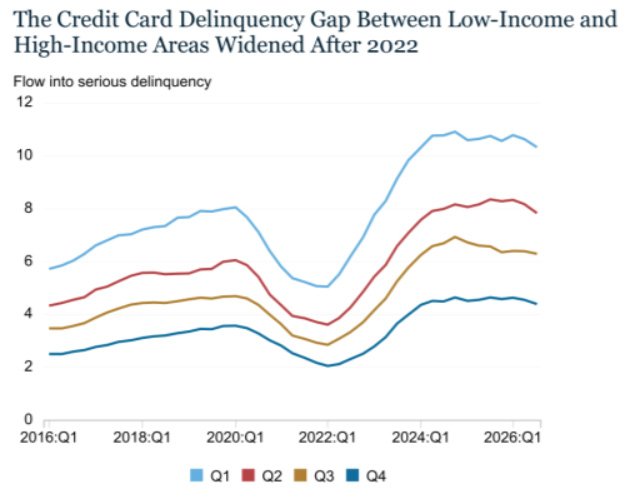
Original chart: Federal Reserve Bank of New York, Liberty Street Economics (Nov. 10, 2026).
For lawyers, the widening gap matters more than the recent small downturn in the lines. Clients do not arrive with abstract “average” debt burdens. They arrive after rent, groceries, transportation, medical expenses, and interest charges have consumed the margin needed to keep making minimum payments. A household can remain employed and still be insolvent in any practical monthly-budget sense.
A pandemic lending boom comes due
The researchers find that during 2020–22 a larger share of new cards and newly extended credit limits went to borrowers in the lowest-income ZIP-code quartile. The median score at credit-card origination also fell from 699 in 2017–19 to 688 during 2020–22, even as credit scores in the broader population generally improved. Some of the apparent improvement in borrowers’ scores during pandemic forbearances was not necessarily an improvement in their longer-run ability to repay.
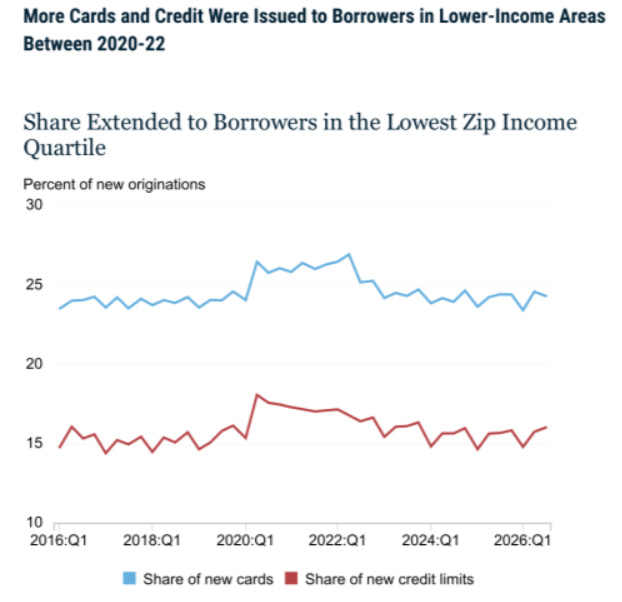
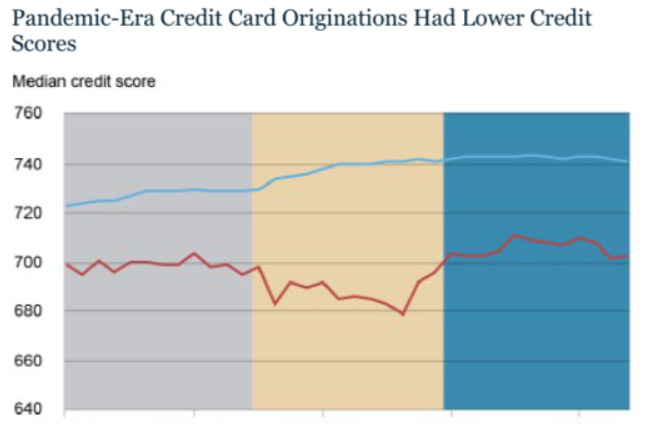
This is not evidence that every low-income borrower was imprudently given credit, or that underwriting alone caused the increase in defaults. The Fed itself emphasizes inflation, borrowing costs, and the winding down of fiscal support. But it helps explain why a strong-looking credit score or an expanding credit limit can mask fragility.
Why the Fed expects some relief
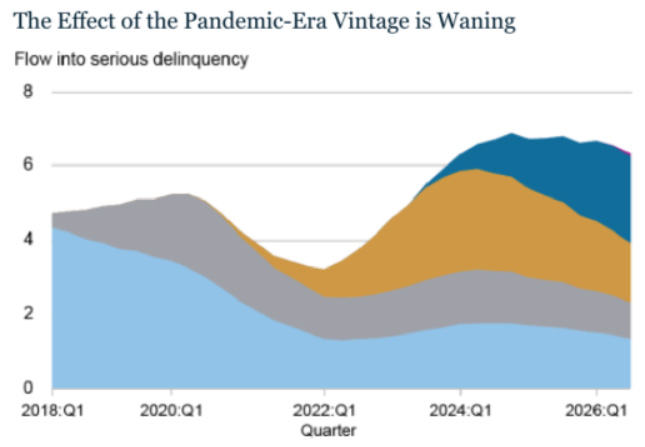
The fourth chart breaks newly serious delinquency down by account-origination vintage. Cards issued in 2020–22 made an unusually large contribution to new serious delinquencies during 2023–24; that contribution is now shrinking. More recently originated accounts have generally had stronger credit quality. Assuming no major economic shock, the researchers expect further improvement in the flow into serious delinquency.
But what does this mean for bankruptcy filings?
There are at least three reasons not to read the Fed’s forecast as a forecast of falling Chapter 7 or Chapter 13 filings. First, new delinquencies are a leading indicator of financial trouble, not a one-for-one measure of bankruptcy demand. Many consumers try to catch up, negotiate with collectors, or endure a lawsuit or garnishment before consulting counsel. Second, even if the number of newly delinquent accounts falls, the stock of families already behind can remain large. A separate August 2026 New York Fed analysis warned that some elevated 90-day delinquency “stock” measures reflect charged-off debts lingering on credit reports rather than fresh default. Third, lost income, housing costs, repossessions, medical debt, and student loans are independent drivers of bankruptcy decisions.
Indeed, filings were still moving upward in 2026. Epiq AACER reported 444,252 individual bankruptcies during January–September 2026, about 11% above the same period in 2025. Individual Chapter 7 filings were up 13% and Chapter 13 filings up 8%. October’s 51,266 individual filings were 2% higher than October 2025. Those figures show that whatever improvement may be underway in the credit-card delinquency pipeline has not yet translated into a national decline in bankruptcy filings.
What to watch in 2027
The best early warning signals will be (1) whether the lowest-income ZIP-code series continues falling or turns back upward; (2) whether newly issued 2025–26 cards begin seasoning into elevated defaults; (3) whether the improvement in new 90-day delinquencies is accompanied by fewer collection suits, garnishments, and repossessions; and (4) whether Chapter 7 and Chapter 13 filings change several quarters later, particularly in regions with more financially vulnerable borrowers.
My expectation is not an imminent collapse in consumer bankruptcy filings. It is that the rate of growth may eventually moderate if the Fed’s improving delinquency flows persist and employment remains reasonably stable. Whether filings actually fall is another question. The most useful lesson from these charts is that yesterday’s lending decisions often become tomorrow’s bankruptcy consultations—and the families least able to absorb financial shocks remain the most exposed.
Sources
Lee, Mangrum, Scally, Sinha & van der Klaauw, “A Look at the Wider Divide in Credit Card Delinquency by Income,” Liberty Street Economics (Nov. 10, 2026), https://doi.org/10.59576/lse.20261110.
Federal Reserve Bank of New York, “How Distressed Are Consumers? Reconciling Diverging Credit Card Delinquency Measures” (Aug. 11, 2026).
Epiq AACER, bankruptcy filing releases (Oct. 8 and Nov. 6, 2026).
To read a copy of the transcript, please see:
Blog comments